Why Your Kajabi Community Isn't Getting Engagement (And What to Fix)
If you've ever built an online community and watched it slowly go quiet, you know the feeling.
You set it up. You invited people. You posted a welcome message.
And then… nothing.
A few people introduced themselves in week one. Maybe someone asked a question. But now it's quiet. You're posting into the void. Members are still paying, but nobody's showing up.
If this sounds familiar, you're not alone. It's one of the most common frustrations among Kajabi users who have a community feature but can't figure out why it isn't working.
The good news? The problem is almost never the platform. Kajabi's community feature is solid. The problem is a fundamental misunderstanding of what an online community is actually designed to do—and what it isn't.
Once you understand that distinction, everything changes. You stop trying to force your community to do things it was never built for, and you start using it for what it does brilliantly.
In this post, we're breaking down the most common mistakes that kill Kajabi community engagement—and exactly what to do instead.
If you're not on Kajabi yet, then come try it out for FREE for a full 45 days — plus get some exclusive bonuses we've put together to help you get started faster.

What Is a Kajabi Community? (Quick Answer)
A Kajabi community is a space for connection, conversation, support, and shared experience. It's where people come to interact. Members can ask questions, share wins, and get support. They feel like they're part of something bigger than just consuming content alone. It's designed to create ongoing relationships and engagement—not one-time consumption. Think of it less like a classroom and more like a gathering space where people come to be seen, heard, and to move forward together.
👉Check out the Community Product in Kajabi free for 45 days
Why Most Kajabi Communities Go Quiet
Before we get into the specific mistakes, let's get clear on something most people skip entirely.
Most communities don't go quiet because the platform isn't working. They go quiet because the owner is asking the community to do something it was never designed to do.
Every mistake on this list comes back to the same root cause: a mismatch between what an online community is built for and what people expect it to do.
When someone is clear on what his or her community actually is—and what it isn't—the path forward becomes obvious.
Mistake #1: Treating a Community Like a Content Delivery Platform
This is the biggest one. And it's the mistake we see most often.
Someone builds their Kajabi community and immediately starts uploading training videos, creating resource libraries, and building out entire learning paths inside it.
Then they wonder why nobody's engaging.
An online community is not a content delivery system.
A community is not designed to replace courses. It's not built to house step-by-step training or long-form lessons. It's not meant to be a library where people go to watch videos in a specific order or download workbooks and templates.
That's what courses and programs are for. Those are structured learning containers. A community is meant to support those containers—not replace them.
Here's a simple way to think about it:
If someone knows how to crochet a hat, the training belongs in a course with structured modules and lessons. The community is where they come afterward and say, "Hey, I'm stuck on step three, can anyone help?" Or, "I just finished my first hat and my daughter loves it!" with a photo attached.
The community supports the learning. It doesn't deliver it.
Mistake #2: Treating a Community Like a Social Media Platform
The second mistake is expecting the Kajabi community to behave like Instagram or Facebook.
It won't. And that's intentional.
A private Kajabi community doesn't have stories, reels, algorithms, or infinite scrolling. There's no viral potential. There's no dopamine loop keeping people glued to their screens.
Some people see that simplicity and feel disappointed. Like the platform is missing something.
It's not missing anything. That simplicity is a feature.
It keeps the space focused. It keeps the experience clean. It keeps your members from getting distracted by everything else competing for their attention.
When someone logs into a Kajabi community, they're not being pulled in seventeen directions by ads, trending content, and notifications from people they barely know. They're in their space, with their people, focused on the thing they came there for.
That's more valuable than an algorithm.
Mistake #3: Using a Community as a Replacement for Email
This one catches people off guard.
Some community builders get so excited about their Kajabi community that they stop emailing their members entirely. "They're all in the community now. I'll just post there."
A community is not a replacement for email.
Not everyone checks the community every day. Some members log in weekly. Some log in monthly. Some only log in when they get a notification.
Important announcements, updates, and time-sensitive information should still go through email. Because not everybody checks the community daily.
Think of a community as one piece of an entire ecosystem—not the whole thing.
Mistake #4: Building a Static Resource Hub Instead of a Living Space
Here's a question worth sitting with: Is your community a living space or a static resource hub?
A static resource hub is somewhere people visit once. They download what they need and leave. There's no reason to come back because nothing changes.
A living space is somewhere people return to regularly. It's active. It's evolving. Things are happening in real time.
If a community is full of pinned posts, resource downloads, and reference documents—but no active conversation—it's a resource hub. And resource hubs don't get engagement.
Communities thrive when they feel alive.
What does "alive" look like? Weekly conversation prompts where members share their perspective. Members share wins every Friday. Someone asks a question and three other people jump in to help. Real back-and-forth happening in the comments.
That's the difference between a community people return to and one they forget exists.
Mistake #5: Seeing the Simplicity as a Limitation
A lot of people come to Kajabi expecting the community to have all the features of a full social platform. And when they realize it's simpler than that, they feel disappointed—or even limited.
This is worth addressing directly because it shapes how people use—and misuse—the platform.
Kajabi's community is intentionally simple. It's not Circle. It's not Facebook. It's not trying to be.
And that simplicity is one of its biggest strengths.
It keeps the experience focused. It keeps members from getting distracted. It keeps most people from overbuilding and overwhelming themselves. It keeps the community easy to navigate, easy to maintain, and easy to engage with.
It doesn't need a thousand features to create a powerful community experience. It just needs clarity, intention, and consistency.

What a Thriving Kajabi Community Actually Looks Like
Now that we've covered what not to do, let's talk about what most people are actually aiming for.
A thriving community is one where things are actually happening. Weekly conversation prompts that invite members to share. Members share wins every Friday. Someone asks a question and three other people jump in to help. Real back-and-forth in the comments.
That's what a living space looks like—and that's what you're building toward.
It's also a community that supports other people’s offers rather than replacing them. If someone has a course, the community is where people ask questions about what they're learning and share their progress. If someone has a membership, it's where people connect between content drops and stay engaged month to month. If someone has a coaching program, it's where people continue the conversation between calls and stay accountable to each other.
The community enhances the experience and deepens the relationship with the members. It doesn't do the teaching. It doesn't deliver the curriculum. It holds the space for everything else to work better.
Getting there takes time. It takes consistency. And it takes showing up even when it feels like nobody's watching—because in the early days, it often feels that way.
But when it clicks? When members start showing up for each other without someone having to prompt it? That's when we know they have built something real.
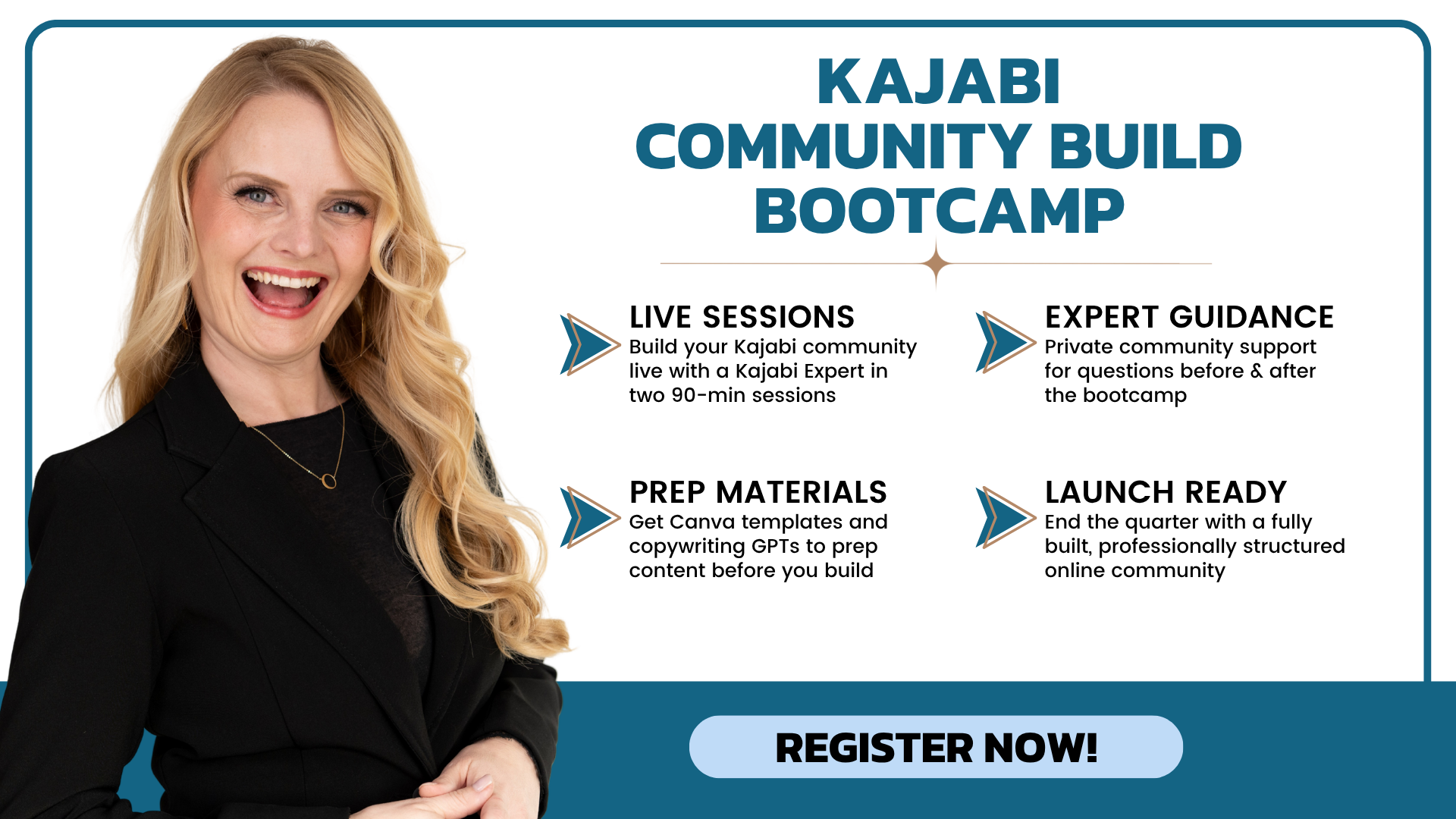
Ready to stop guessing and actually build your Kajabi community with expert guidance?
Join us for the Kajabi Community Build Bootcamp — a hands-on experience where you'll walk away with a fully functioning, launch-ready community.
👉 Save your spot in the Bootcamp
Common Questions About Kajabi Community Engagement
Why is nobody posting in my Kajabi community?
The most common reason is that the community is being used as a content delivery platform instead of a conversation space. A community is designed to support courses and programs—not replace them. When members know it's a place to connect around the work rather than consume the work, the dynamic shifts completely.
Is Kajabi's community feature too simple compared to other platforms?
The simplicity is intentional—and it's actually an advantage. It keeps members focused, reduces distraction, and makes the community easier to manage. It doesn't need every feature a full social platform offers to create a space where people genuinely connect. It just needs clarity, intention, and consistency.
Should I keep emailing my members if I have a community?
Yes, absolutely. A community is one piece of an ecosystem—not the whole thing. Not everyone checks the community daily, so important announcements and time-sensitive information should still go through email.
Can my Kajabi community replace a Facebook Group?
For most creators, yes—and it's often a better experience. A Kajabi community lives inside your branded platform, away from the distractions of social media. Members aren't competing with ads, personal feeds, or other groups for attention. The focus stays on the content and the people.