Is Kajabi Worth It in 2026? Here's What's Actually Happening
If you've been on social media lately, you've probably seen the drama.
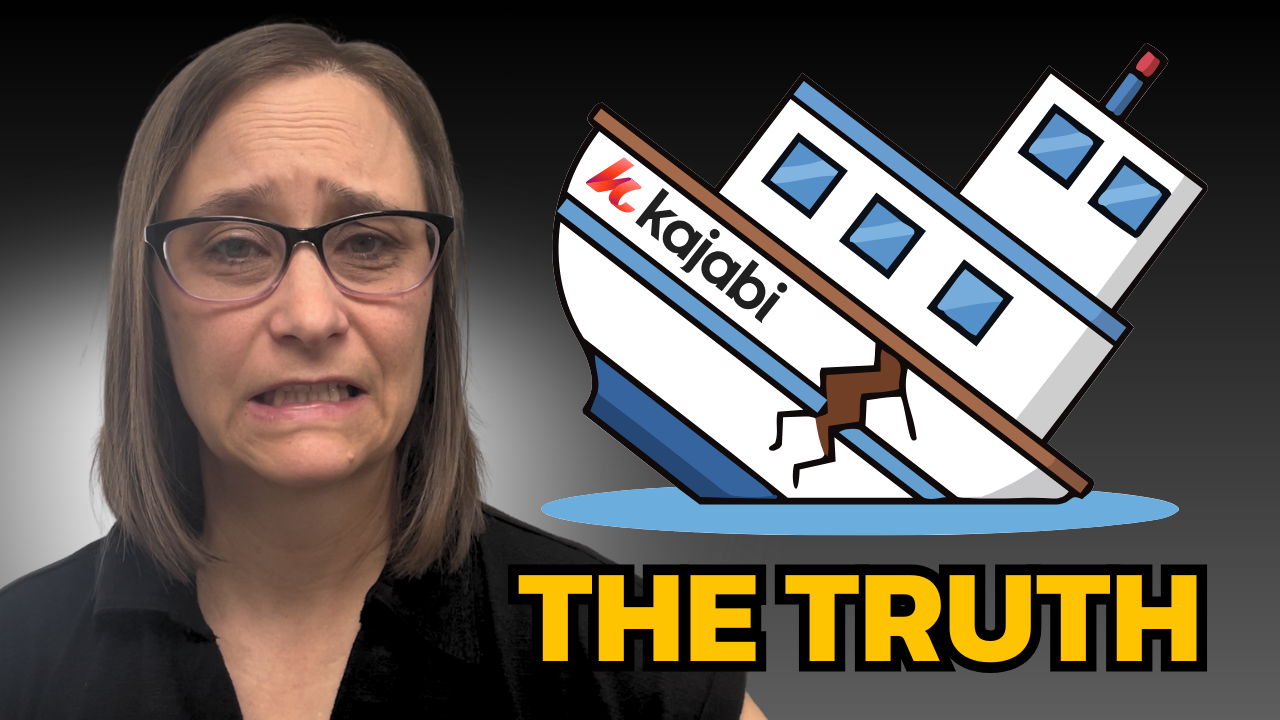
"Kajabi is a sinking ship."
"Everyone's leaving Kajabi."
"The pricing changes are killing the platform."
The questions are everywhere: Should you jump ship? Is Kajabi dying? Should you move to Skool or Circle or whatever the hot new platform is this month?
But here's what's interesting: We work inside Kajabi accounts every day—building sites, setting up automations, migrating communities, and troubleshooting technical issues across multiple industries—are seeing something completely different from what's circulating on social media.
The reality inside active Kajabi accounts doesn't match the narrative online. And that gap between perception and reality is what this post is about.
In this breakdown, you'll get the unfiltered truth about what's actually happening with Kajabi in 2026—the good, the bad, and what you need to know before you make any decisions about staying or leaving.
What Is Kajabi? (Quick Answer for Anyone New Here)
Kajabi is an all-in-one platform for online course creators, coaches, and membership site owners. It combines website hosting, course delivery, email marketing, landing pages, checkout pages, community features, and analytics in one place. Instead of juggling Teachable + ConvertKit + Circle + Stripe + WordPress, you run everything from Kajabi. As of 2026, Kajabi hosts over 75,000 businesses and has processed billions in creator revenue.
What Everyone's Talking About
Here's what sparked the controversy:
1. Pricing Changes (September 2024)
Kajabi raised prices and restructured their plans. For example, the old Growth plan went from $199/month to $249/month. They also changed what features were included at each tier.
Why people are upset:
- Existing customers saw price increases
- Some features were restricted to higher tiers
- No grandfathering for long-time users (initially—they later added some protections)
2. Partner Program Changes
Kajabi changed their affiliate/partner program structure, which affected a lot of people who promoted Kajabi and earned commissions.
Why people are upset:
- Lower commission rates for some partners
- Changed qualification requirements
- Affected income for people who relied on Kajabi affiliate revenue
3. Founder Returns
Kenny Rueter, Kajabi's founder, came back as CEO after stepping away. This sparked speculation about the company's direction and stability.
Why people are talking:
- Leadership changes always create uncertainty
- People wondered if the company was in trouble
- Speculation about what this means for the platform's future
What We're Actually Seeing Inside Kajabi Accounts (The Reality)
We work in dozens of different Kajabi accounts every week. Here's what's actually happening:
1. Nobody's Leaving
The narrative: "Everyone's jumping ship to Skool/Circle/Stan Store."
The reality: Out of all our clients—across different niches, different business sizes, different revenue levels—exactly zero have left Kajabi.
Not one.
Some have talked about it. Some have explored alternatives. But when they actually compare features, migration effort, and total cost of ownership, they stay.
Why?
Because moving platforms is a massive pain. You have to:
- Migrate all your content
- Rebuild your sales pages
- Reconnect your payment processor
- Move your email list
- Retrain your team
- Update all your links
- Risk breaking things during the transition
And for what? To save $50/month? To get one feature that Kajabi doesn't have yet?
For most people, it's not worth it.
2. The Platform Is Getting Better, Not Worse
The narrative: "Kajabi is stagnant and falling behind."
The reality: Kajabi has released more significant updates in the last 12 months than in the previous three years combined.
Major updates we've seen rolled out:
- Enhanced checkout (Mid 2025): Complete redesign with multiple payment options, custom design, templates
- Advanced automations (February 2026): Branching logic, advanced wait nodes, winback campaigns
- Community improvements (ongoing): Better engagement tools, badges, audio sharing
- Global brand settings: Set your brand once, applies everywhere
- Cohort courses: Date-based content drip for group experiences
- Improved analytics: Better reporting and insights
These aren't minor tweaks. These are features people have been requesting for years.
3. The Pricing Complaints Are Louder Than the Reality
The narrative: "Kajabi is pricing out small creators."
The reality: Yes, prices went up. But let's look at the actual numbers.
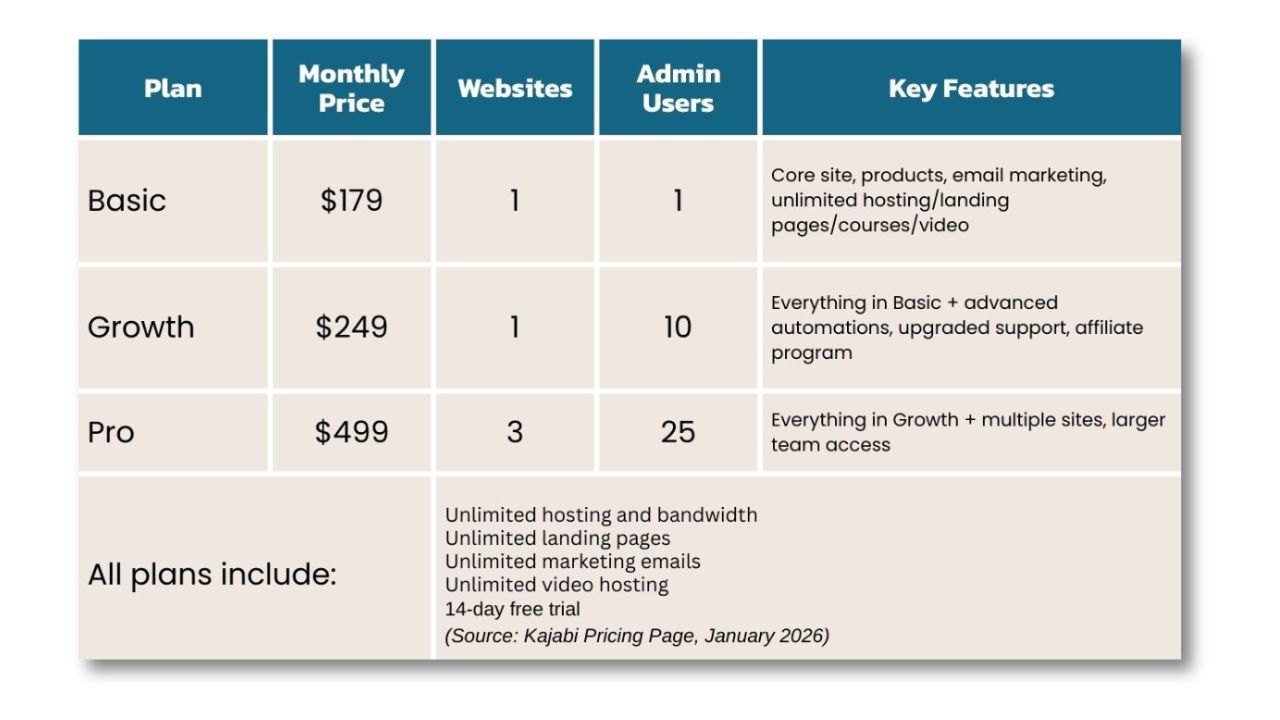
Current Kajabi pricing (as of January 2026):
- Basic: $179/month
- Growth: $249/month
- Pro: $499/month
What you get at $249/month (Growth plan):
- Unlimited products
- Unlimited landing pages
- Unlimited email marketing
- Unlimited video hosting
- Full community features
- Advanced automations
- Affiliate program
- 10 admin users
What that replaces:
- Course platform (Teachable/Thinkific): $79-$119/month
- Email marketing (ConvertKit/Mailchimp): $29-$79/month
- Community platform (Circle/Mighty Networks): $39-$99/month
- Landing page builder (Leadpages/ClickFunnels): $37-$97/month
- Video hosting (Vimeo/Wistia): $19-$99/month
Total if you bought separately: $203-$493/month
Kajabi at $249/month: Actually competitive, sometimes cheaper.
Plus: You're managing one platform instead of five. One login. One support team. Everything connected.
Is it expensive? Yes. Is it overpriced? Not when you look at what it replaces.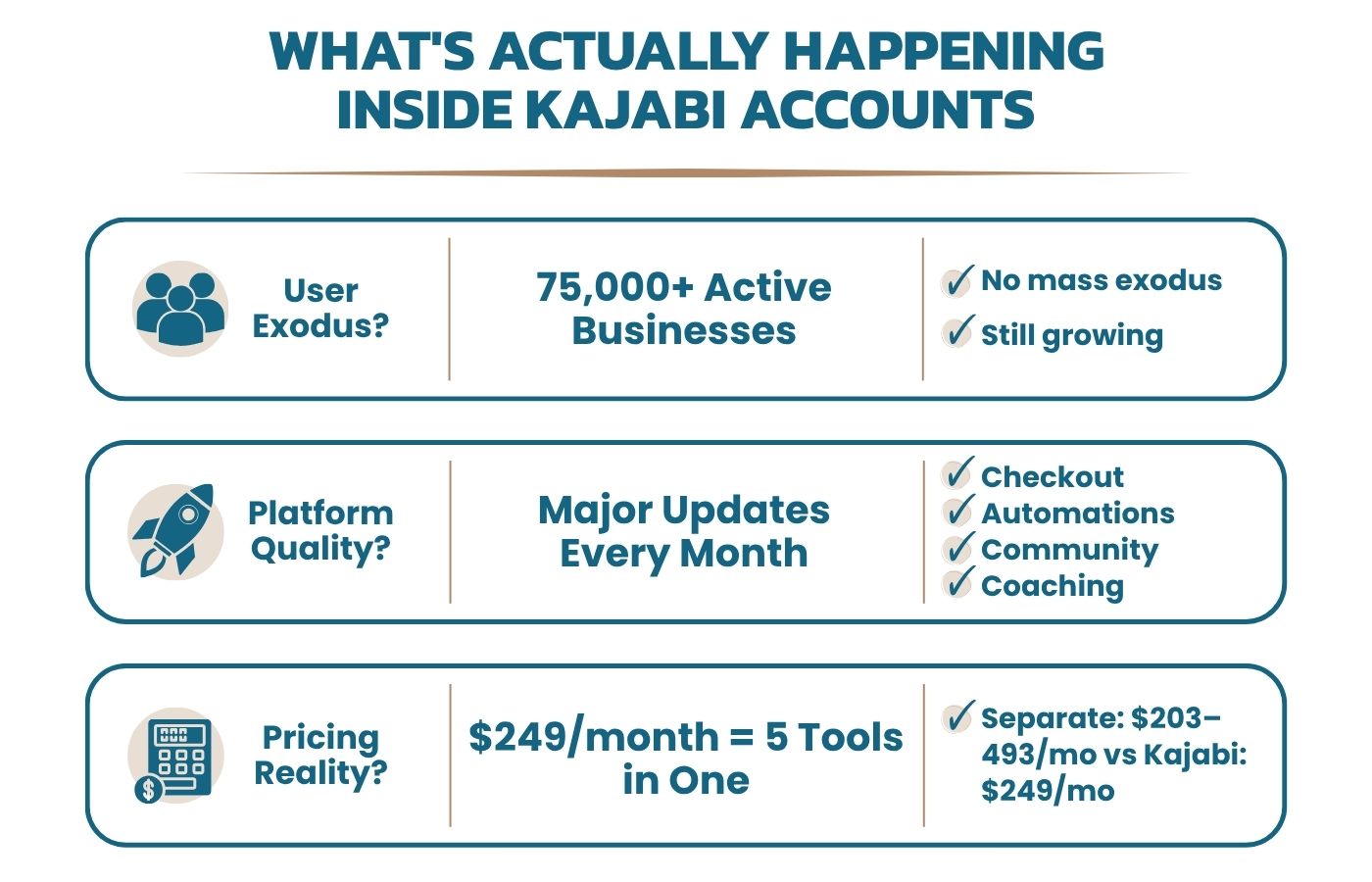
What the Founder's Return Actually Means
Kenny Rueter came back as CEO, and people freaked out. "The company must be in trouble!" "They're desperate!"
Here's what actually happened:
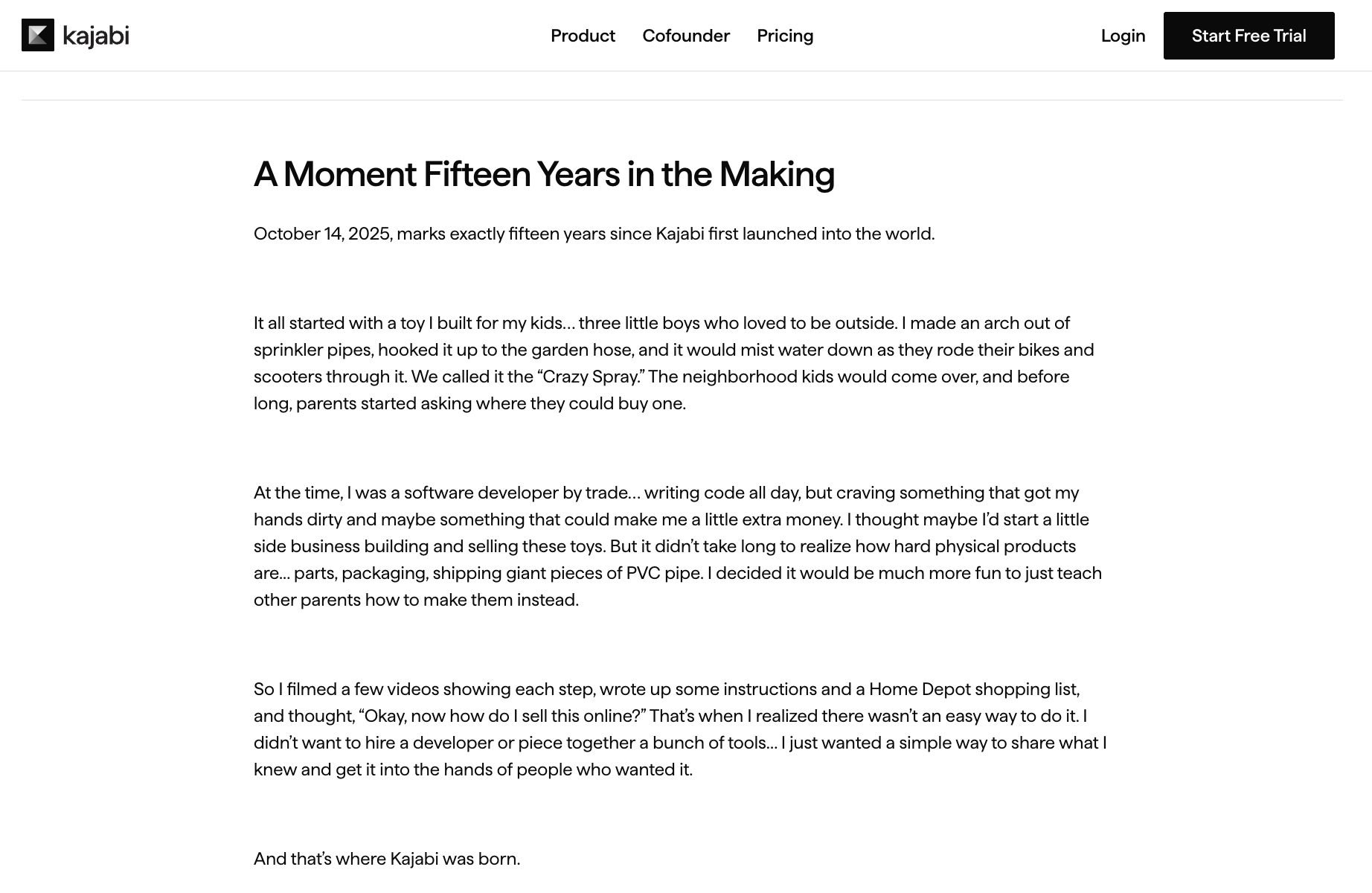
Kenny released a manifesto explaining Kajabi's new direction. You can read it here.
1. Kajabi Is Refocusing on "Human Expertise"
They're positioning Kajabi as the platform for real experts—people whose knowledge comes from lived experience, not just information they learned online.
What this means:
- Less focus on "make money online" gurus
- More focus on coaches, educators, practitioners, clinicians
- Platform features designed for transformation, not just information delivery
2. They're Prioritizing Depth Over Breadth
Instead of trying to be everything to everyone, Kajabi is doubling down on what they do best: helping experts build real businesses around their knowledge.
What this means:
- More features for coaching and high-touch programs
- Better community and engagement tools
- Less focus on competing with every new shiny platform
3. They're Listening to Users (Finally)
The enhanced checkout, advanced automations, and other recent updates? Those came directly from user feedback.
What this means:
- The product roadmap is driven by what users actually need
- Features that have been requested for years are finally getting built
- The platform is evolving based on real use cases, not just what's trendy
Our take: This is a good thing. A founder returning with a clear vision and a commitment to listening to users is not a red flag—it's a green flag.
The Real Question: Is Kajabi Worth It in 2026?
Let me break this down by situation, because the answer isn't the same for everyone.
Kajabi Is Worth It If:
✅ You want everything in one place
If you're tired of managing multiple platforms, integrations that break, and five different support teams, Kajabi is worth it. The consolidation alone saves hours every month.
✅ You're building a real business (not a side hustle)
If you're serious about scaling, Kajabi gives you the infrastructure to do it. You're not going to outgrow it at $10K/month or $100K/month or even $1M/month.
✅ You value your time
Yes, Kajabi costs more than some alternatives. But if you're spending 10 hours a month managing integrations, troubleshooting broken automations, or switching between platforms, what's your time worth?
✅ You need advanced features
If you want sophisticated automations, multiple payment options, community features, affiliate programs, and professional checkout pages, Kajabi has all of it. Most cheaper alternatives don't.
✅ You're a coach, educator, or expert (not just selling info products)
Kajabi's new direction is perfect for people who deliver transformation, not just information. If you're running coaching programs, cohort courses, or high-touch memberships, Kajabi is built for you.
Kajabi Is NOT Worth It If:
❌ You're just starting and have no revenue yet
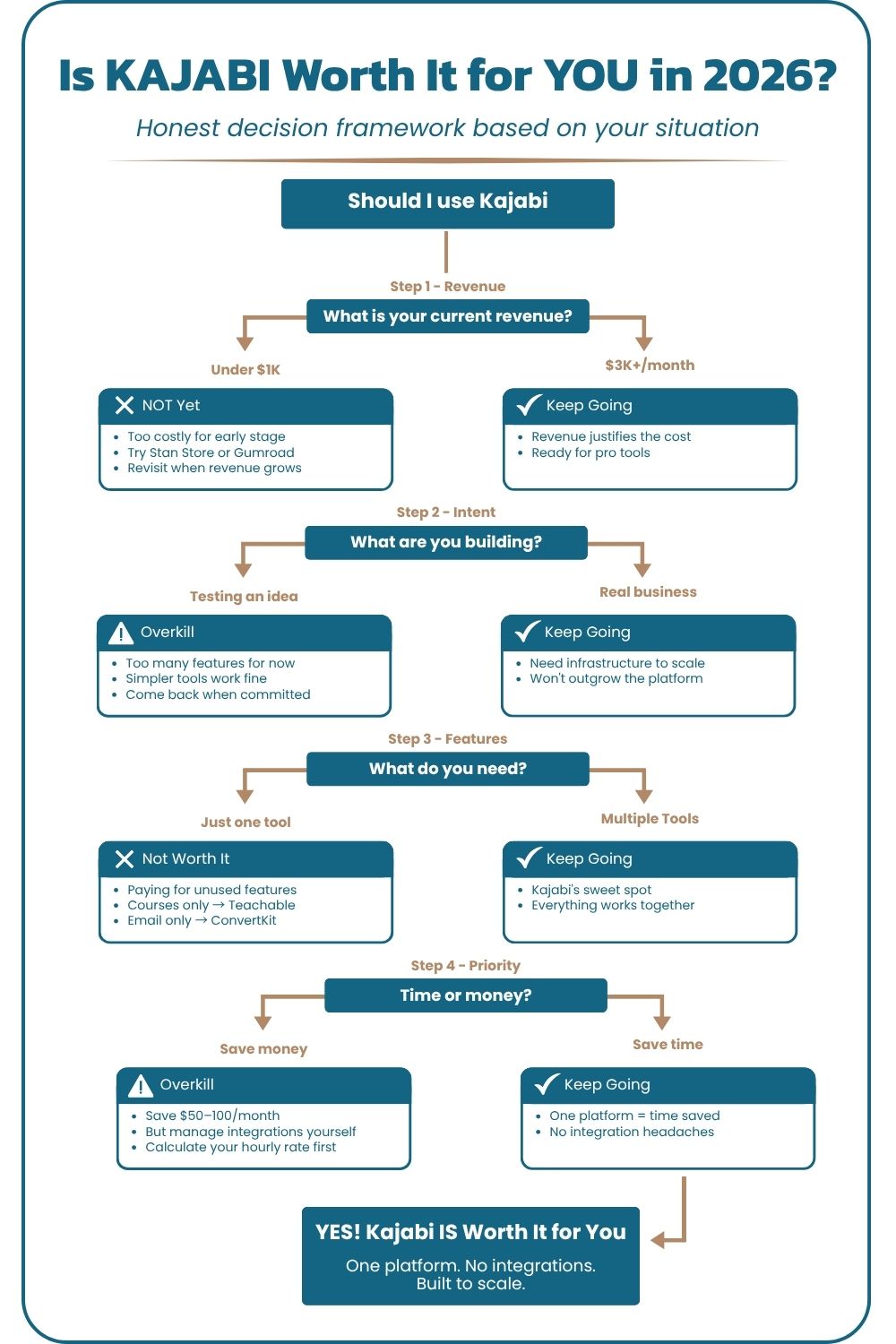
If you're pre-revenue or making less than $1,000/month, Kajabi is probably overkill. Start with something simpler and cheaper (like Stan Store or Gumroad), then migrate to Kajabi when you're ready to scale.
❌ You only need one feature
If all you need is a simple course platform and nothing else, Kajabi is too much. Use Teachable or Thinkific.
If all you need is email marketing, use ConvertKit.
If all you need is a community, use Circle.
Kajabi's value is in the combination, not individual features.
❌ You're not willing to learn the platform
Kajabi is powerful, but it has a learning curve. If you want something you can set up in 30 minutes with zero learning, Kajabi isn't it.
❌ You're chasing the "next big thing"
If you're the type of person who switches platforms every six months because something new and shiny came out, Kajabi isn't for you. It's for people who want to build on a stable, mature platform.
What About the Alternatives? (Honest Comparison)
Let me address the platforms people keep mentioning as "Kajabi killers."
Skool
What it's good for: Simple community + course combo, gamification, low price ($99/month)
What it's missing: No email marketing, no landing pages, no checkout customization, no advanced automations, no website hosting
Our take: Great for community-first businesses. Not a Kajabi replacement unless you're willing to add 3-4 other tools.
Circle
What it's good for: Robust community features, beautiful interface, flexible pricing
What it's missing: No course hosting, no email marketing, no checkout pages, no landing pages
Our take: Best-in-class community platform. But you'll need Teachable + ConvertKit + Stripe on top of it.
Stan Store
What it's good for: Super simple, mobile-first, great for creators with Instagram/TikTok audiences
What it's missing: No email marketing, limited customization, no advanced features, no community
Our take: Perfect for beginners or simple product sales. You'll outgrow it fast if you're building a real business.
Thinkific/Teachable
What they're good for: Course hosting, simple setup, lower price
What they're missing: No email marketing, limited landing pages, no community, basic automations
Our take: Solid course platforms. But you'll need ConvertKit + Circle + Leadpages to match Kajabi's features.
The pattern: Every alternative is cheaper, but you end up needing 3-5 tools to replace what Kajabi does in one.
The Pricing Breakdown: What You Actually Pay (January 2026)
Let's be transparent about what Kajabi costs and what you get.
Our Honest Recommendation
If you're solo and just starting: Basic ($179/month) is fine. You get everything you need.
If you're growing and have a team: Growth ($249/month) is the sweet spot. Advanced automations and 10 admin users make it worth the extra $70.
If you're running multiple brands or programs: Pro ($499/month) gives you 3 separate sites and communities.
What's Coming Next for Kajabi (Based on What I'm Seeing)
We don't have insider information, but based on the updates we've seen and the direction Kenny outlined in the manifesto, here's what I expect:
1. More Coaching-Focused Features
Expect better tools for:
- One-on-one coaching
- Group coaching
- Session scheduling
- Client management
2. Deeper Community Integration
The community features are good, but they're not as robust as Circle yet. I expect Kajabi to keep improving:
- Better engagement tools
- More gamification
- Improved mobile experience
- Better moderation tools
3. AI Features
Every platform is adding AI. I'd be surprised if Kajabi doesn't add:
- AI-powered email writing
- AI course outline generation
- AI analytics insights
4. More Automation Improvements
The February 2026 automation updates were huge, but there's still room for:
- More trigger options
- Better visual automation builder
- More advanced conditional logic
Should You Stay or Should You Go? (Decision Framework)
Here's how to decide:
Stay on Kajabi If:
- You're making at least $3,000/month (Kajabi pays for itself)
- You value having everything in one place
- You need advanced features (automations, community, affiliate program)
- You have a team (multiple admin users)
- You're building a long-term business (not just testing an idea)
- The recent updates solve problems you've had
Consider Leaving If:
- You're pre-revenue or making less than $1,000/month
- You only use 1-2 features (just courses, or just email)
- You're willing to manage 3-5 different platforms
- You need a feature Kajabi doesn't have and won't add
- The price increase genuinely makes it unaffordable
Don't Leave Just Because:
- ❌ You saw drama on social media
- ❌ Someone said "everyone's leaving"
- ❌ A new platform launched with one cool feature
- ❌ You're frustrated with one thing (most issues can be solved)
Our rule: Don't leave a platform until you've fully explored the alternative and confirmed it actually solves your problems better.
The Bottom Line: Is Kajabi a Sinking Ship?
No.
Is Kajabi perfect? No.
Are there legitimate complaints? Yes.
But a sinking ship doesn't release major feature updates every month. A sinking ship doesn't have a founder return with a clear vision and manifesto. A sinking ship doesn't have 75,000+ active businesses and billions in processed revenue.
What's actually happening:
Kajabi is maturing. They're raising prices (like every SaaS company does). They're refocusing their positioning. They're improving the product based on user feedback.
Some people are upset about the changes. That's normal. But the platform itself is stronger than it's ever been.
Our prediction: In 12 months, we'll look back at this "Kajabi is dying" drama and laugh. The platform will be better, the features will be more robust, and most of the people who threatened to leave will still be there.
Ready to Try Kajabi (or Give It Another Look)?
If you're not on Kajabi yet and want to see what all the fuss is about—or if you left and you're considering coming back—I have an exclusive offer you can't get anywhere else.
Get an extended 45-day free trial of Kajabi (not available through Kajabi directly—only through our partner link) plus exclusive bonuses.
This is the longest trial period available anywhere, giving you plenty of time to test the platform, explore the new features, and decide if it's right for your business.
👉 Get your extended 45-day Kajabi trial + exclusive bonuses
Common Questions About Kajabi in 2026
Is Kajabi actually losing users?
Kajabi hasn't released official user numbers, but based on what I'm seeing in the community and across client accounts, there's no mass exodus. Some people left after the pricing changes, but the platform is still growing overall.
Are the pricing changes permanent?
Yes. The current pricing structure (Basic $179, Growth $249, Pro $499) is the new standard. Kajabi has said they don't plan additional increases in the near term, but like any SaaS company, prices could change in the future.
Should I wait for Kajabi to add more features before joining?
No. If you need a platform now, join now. Kajabi is fully functional and feature-rich today. Waiting for "one more feature" means you're delaying your business. You can always take advantage of new features as they're released.
What if I'm on an old grandfathered plan?
If you're on an old plan with better pricing, stay on it as long as you can. Kajabi has said they'll honor grandfathered plans for existing users. Don't upgrade unless you need features that are only available on new plans.